A club's asset register is usually a whiteboard, and the whiteboard is usually wrong. The tents came back on Sunday — three of them. The drill is "with somebody". The projector was borrowed for a council meeting in March and nobody has seen it since, which nobody notices until the next council meeting.
Golden Inventory arrives as the asset-management mode: the app opens on the equipment register instead of a dashboard, items are called Assets & Supplies, work orders are Maintenance orders, and the sales side of the product — invoices, POS, price lists — folds away under "More". A club rarely sells anything.
Monday 09:00 — one number that matters
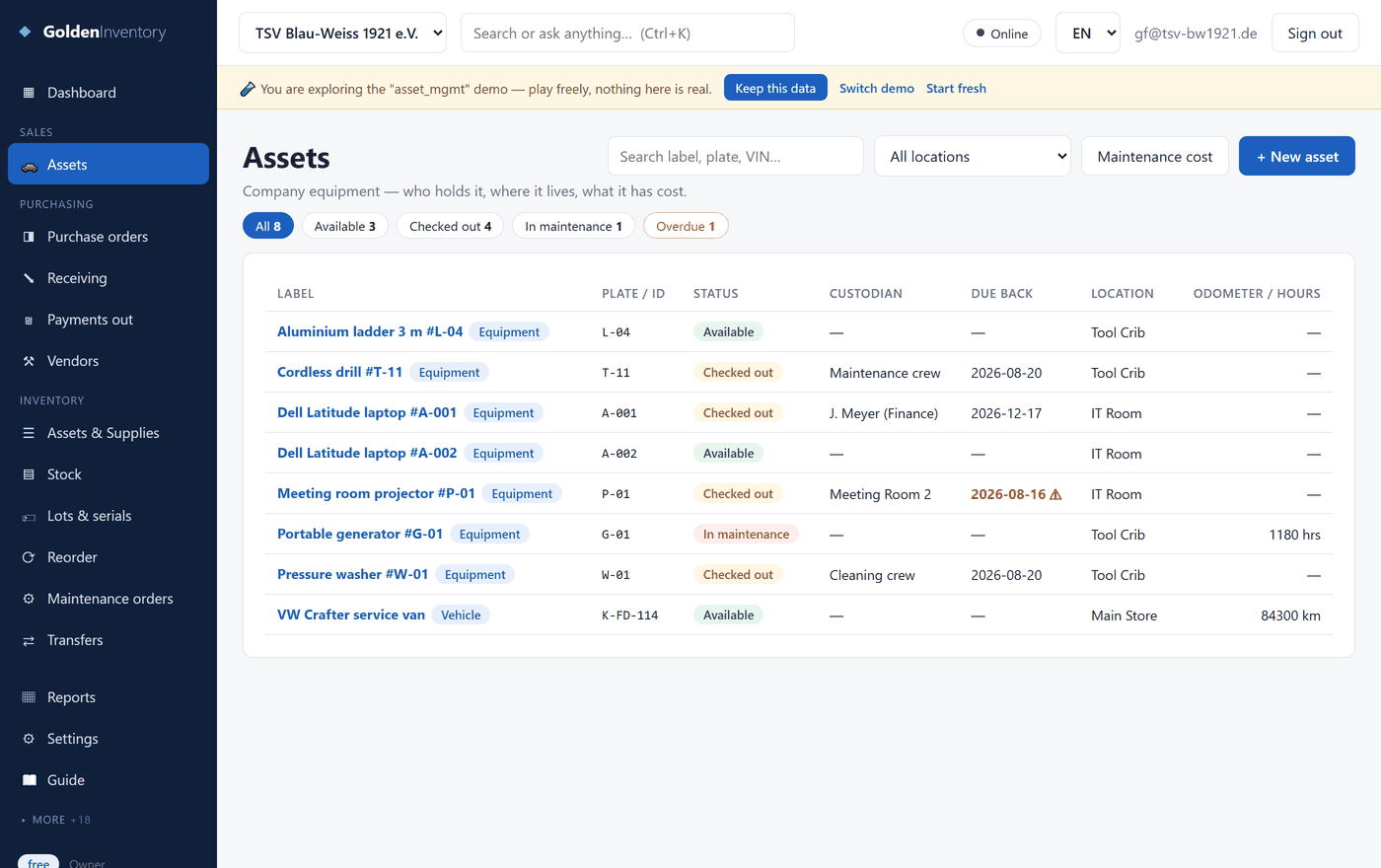
The register opens on four chips: available, checked out, in maintenance, overdue. The last one is the only number the equipment manager actually reads on a Monday. Today it says 1 — the meeting-room projector, out since the council session, due back three days ago, and the due date is printed in red next to the name of whoever took it.
Tuesday — the U17 trainer arrives
He takes the team kit and four footballs. These are two different things, and the app treats them differently. The kit is an asset: it is checked out to him, with a due-back date, and the register now shows his name against it. The balls are stock: they leave the shelf and the consumable count drops. One counter tracks custody; the other tracks quantity. Confusing the two is how clubs end up with 30 "missing" balls and no idea whether they were lost or simply used.
Wednesday — the generator goes into the workshop
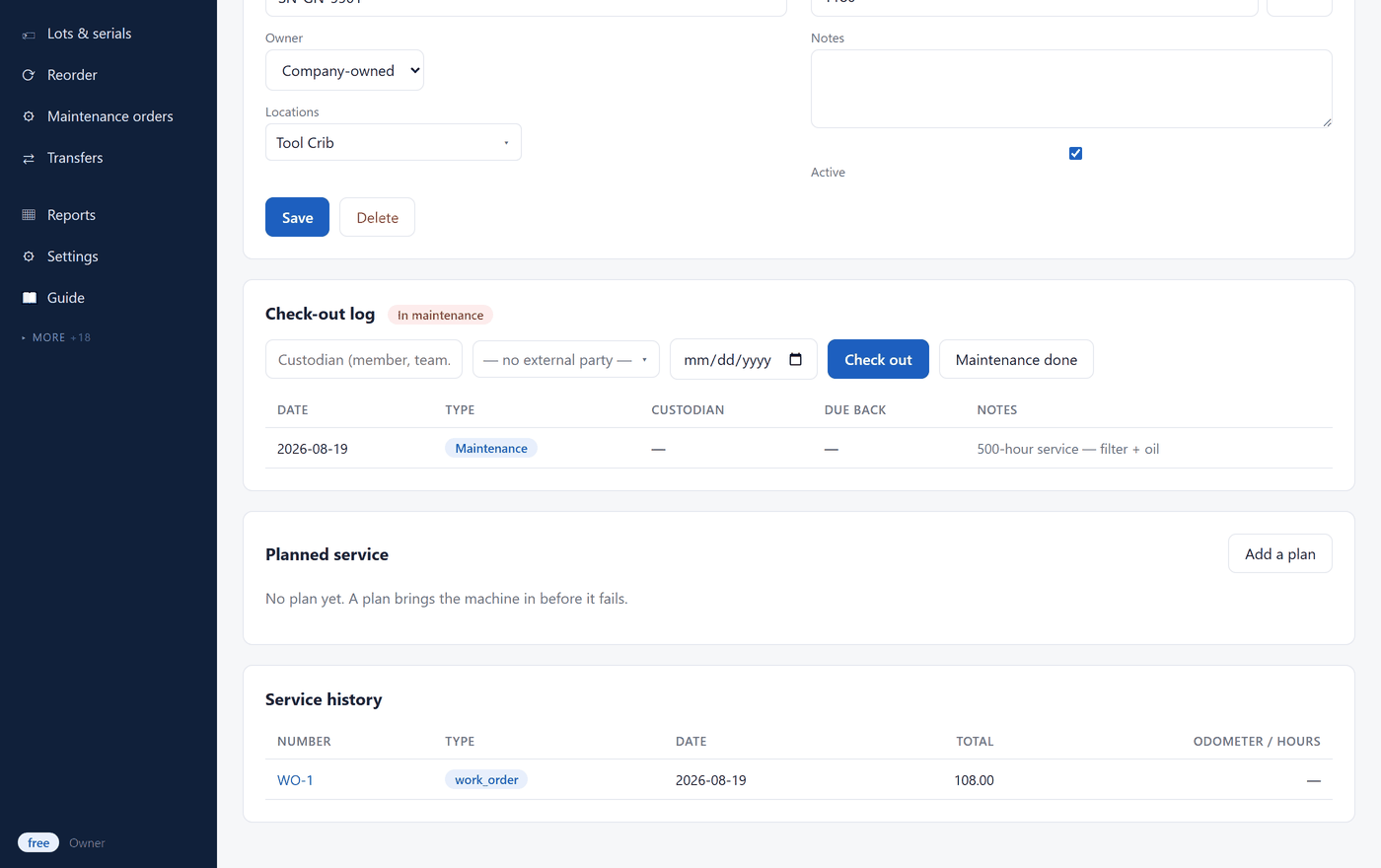
The generator comes back from the market square with 1 180 hours on it, and the 500-hour service is overdue. It is checked in, marked in maintenance, and the work is written as a maintenance order against that machine: a filter, five litres of cleaner and two hours of the caretaker's time.
Approving it takes the parts out of the store and books the cost to the generator. Nothing is assembled and nothing is sold — it is simply what this machine cost to keep running, and it is now on the machine's own record.
Thursday — the minibus and the TÜV
The bus has a planned service: every 730 days, or every so many kilometres, whichever comes first. The plan says the TÜV falls due in November, so the office books the workshop now, while the slot exists. The external invoice is a purchase order linked to the bus — so in-house hours and the garage's bill end up in the same place: what this vehicle costs the club per year.
Friday — the shed has no signal
The groundskeeper takes the second mower out at seven in the morning, standing in a shed where the phone shows one bar and no data. He checks it out anyway. The event sits in the device's outbox and syncs when he walks back past the clubhouse; replaying it twice changes nothing. Equipment tracking that only works where the Wi-Fi reaches is equipment tracking that gets skipped.
Saturday — the partner school
Six tents go out to a school festival. That is a check-out to an external party with a due-back date — the same mechanism as lending to a trainer, but the custodian is an organisation and the return date is a commitment somebody outside the club made. On the following Monday, that is either a green row or a red one.
Quarter-end — the board meeting
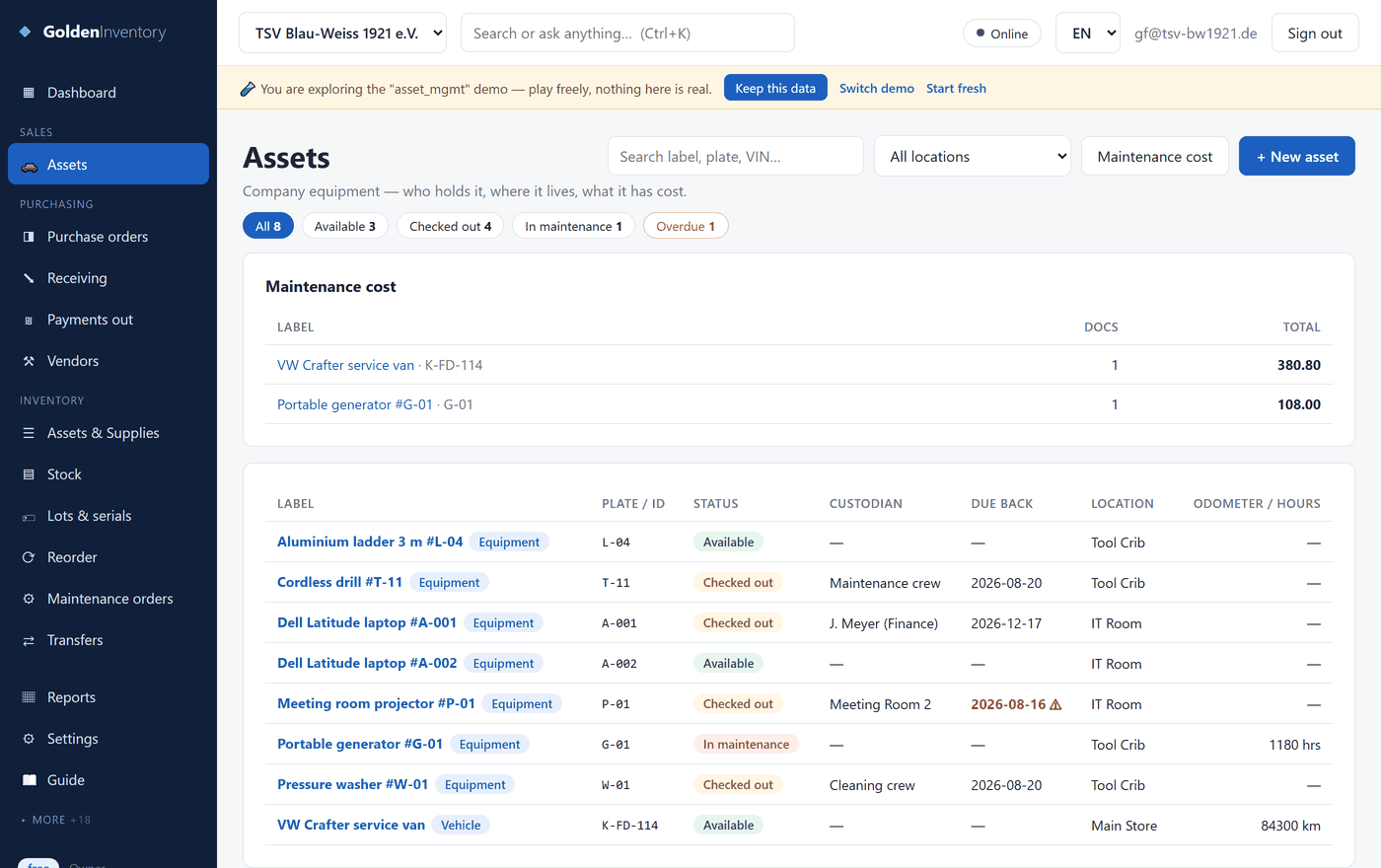
Two screens answer the two questions a treasurer asks. Maintenance cost per asset — which machine is quietly eating the budget, and whether replacing it is now cheaper than servicing it. The register filtered by room — the annual inventory, walked shed by shed, with a list that matches what is standing in front of you.
What actually changed
The club did not become a business. It still lends tents to schools and buys line paint by the can. What changed is that "who has it, since when, and what has it cost us" stopped being three separate memories held by three volunteers — and a thing that is due back on Monday now says so, in red, on Monday.
The register in detail: equipment and device asset register.