Meister Vogel can tell you what a desk costs in his sleep — timber, screws, varnish, six hours on the bench. What he couldn't tell you, before, was what it cost last Tuesday, after the price of oak moved and the offcuts from the cabinet job changed the yield. That number is the whole business.
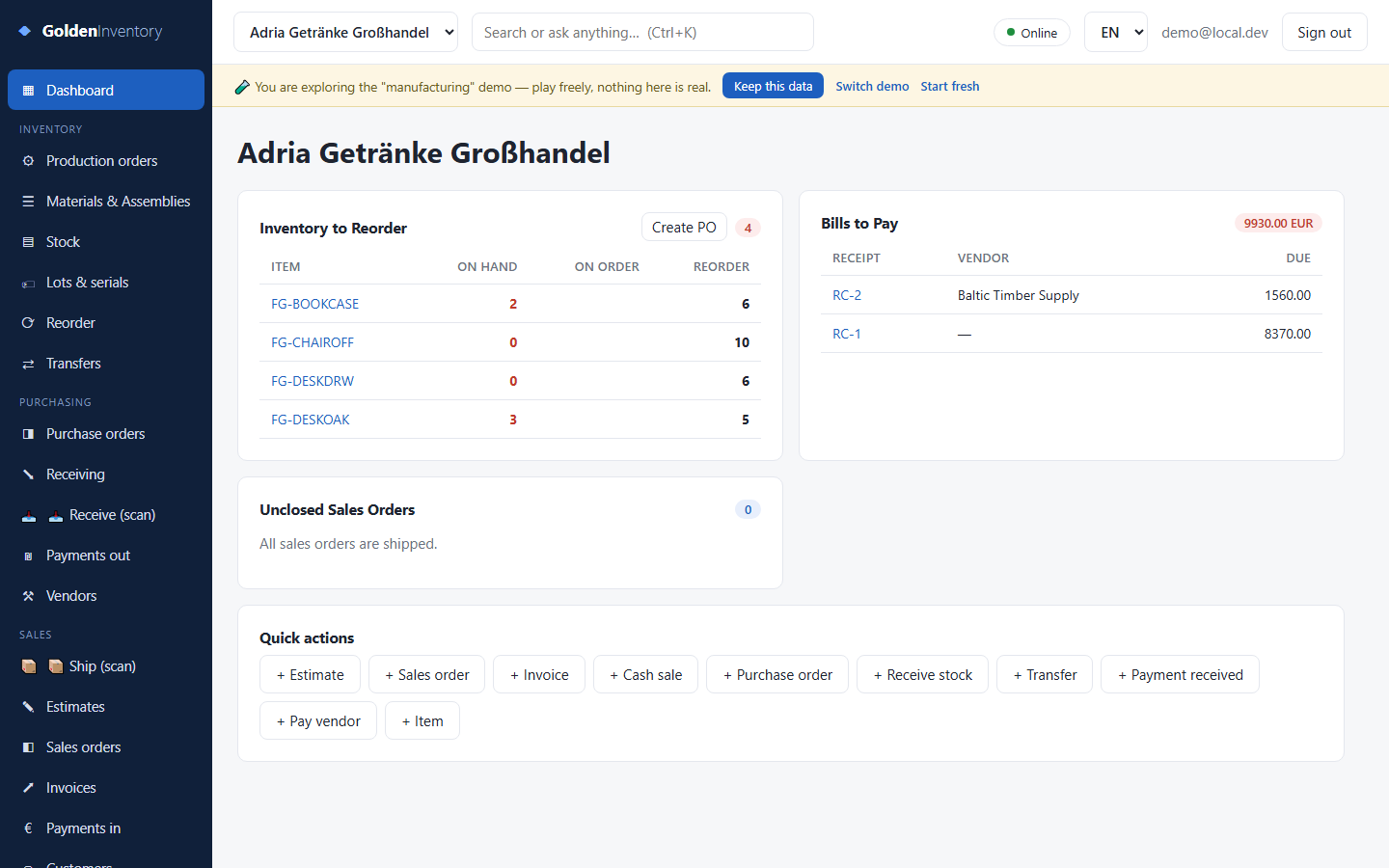
Golden Inventory arrived as the manufacturing mode: Production orders instead of "work orders", Materials & Assemblies instead of a flat item list — and a dashboard that leads with work in progress, component shortages and reorder alerts.
07:00 — the timber arrives
Four cubic metres of oak land at the loading bay. One receiving document, and the units do what workshops actually do: buy by the m³, consume by the board-metre. The stock screen shows board-metres; the ledger stores the base-unit moves underneath. No conversion spreadsheets, no "was that forty boards or four hundred?"
08:00 — five tables, one work order
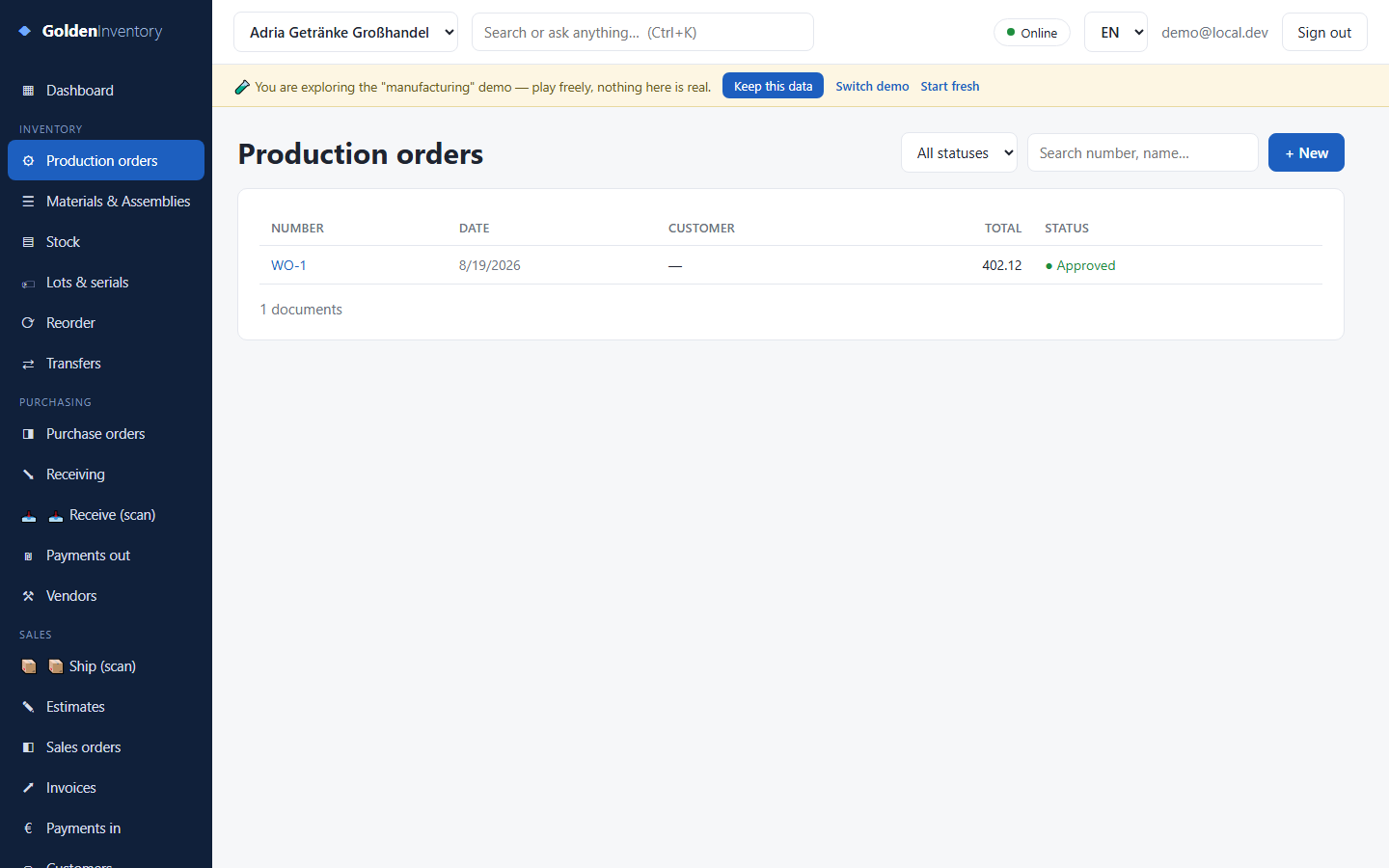
The run for five oak desks is a work order against the BOM: twelve board-metres of oak per table at 92% yield — the yield inflates the demand, because offcuts are part of the recipe — plus screws, varnish and six hours of labour. Fill-from-BOM writes the lines; the dashboard's component-shortage widget flags the finish before the workshop is halfway through the first top.
09:30 — the custom cabinet quote
The architect's office wants a desk with a drawer unit. The estimate copies the BOM lines, adds fourteen hours of labour at the workshop rate, and names the technician — the quote is a costed document, not a guess on a napkin. If they accept eight of ten lines, only those lines convert.
12:00 — the run finishes
Approving the work order consumes the components and posts the assemblies into Finished Goods in one transaction — at moving-average cost that already includes the yield-inflated timber and the labour. The shelf price vs. assembly-cost margin is a report line, not an annual exercise.
14:00 — the rest of the day
Two desks invoice to the furniture store on net-30; the receivables screen tracks the balance. At 15:00 a walk-in buys a bookcase from the showroom — the sale back-flushes the components out of raw materials the moment the receipt prints, so the shop floor's stock is always the truth. A recipe tweak (different screw on one line) is saved back as the new BOM for the next run. And at 16:00 the reorder run turns raw materials below minimum into draft purchase orders.
17:00 — what the week made
The production reports close the loop: work orders in WIP, assembly cost against list price, margin per product. When the month ends, the accountant's questions are already answered — because every desk that left the building took its real cost with it.